

Archive - February 2017
By Gabrielle Moore, Editor-in-Chief
 (Left photo) Mikha Mitchell and her colleagues located on the southside of West 11st Street upon the Capitol lawn in Austin, Texas, Jan. 21. (Right photo) Mitchell and colleagues passing the Capitol on West 11st Street. Photos by Mikha Mitchell.
Powerful. Peaceful. Organized. Respectful.These words have different definitions from one another and varying definitions within themselves. Yet, they all had one thing in common on January 21: they were experienced by several faculty members who were participants of the Women’s March on Washington (WMW).
Majority of those faculty members that were part of the WMW marched in the Sister March in Austin, Texas which had 40,000 to 50,000 demonstrators.
“The march was exceeded by expectations. It was powerful and overwhelming,” reference librarian Mikha Mitchell said. “There [was] an undertone of anger and frustration, but that whole march was about loving each other and respecting each other.”

Librarian Mikha Mitchell and colleagues made buttons along with signs courtesy of the Women’s March on Washington website for their participation in the Sister March in Austin, Texas on Jan. 21. Photo by Mikha Mitchell.
Furthermore, as education Professor Brenda Stubbs put it, the march “was a unifying opportunity” for millions of people across the United States and the world.
“Older women had signs that said such things as, ‘We have fought this fight before. We didn’t think we would have to fight this fight again,’” Stubbs said.
Even though this fight for and protection of women’s rights date all the way back to the late 1800s, the WMW organization arose the day after the Election Day of 2016 and became official on December 9, 2016. The organizers drew a lot of inspiration from the 1997 Million Women March–so much so, in fact, that the 2017 march was originally slated to share a name with its 1997 predecessor. They also drew much inspiration from the many trailblazers of the like of this organization, such as Elizabeth Cady Stanton, Ella Baker, Shirley Chisholm, Angela Davis, and Sylvia Rivera.

The official logo of the Women’s March on Washington. Courtesy photo by Women’s March on Washington.
History Professor Stephanie Kelly describes the organization’s general vision and principles as a “broad umbrella,” and it is because of that massive umbrella that this protest had been “the largest in the history of America.”
Furthermore, the WMW promotes and represents solidarity in all aspects of women’s rights and beyond, as well the acknowledgement of all voices. It is this belief and practice of inclusivity, listening to one another, and seeking to be properly heard that these faculty members also work to bring about in the classrooms.
Stubbs had told a student one time, “I’m not trying to change your value system, but we’re introducing you to things where you can see differently, because that’s important for them to know, especially as first-time college students.”
This concept of open-mindedness to hearing others’ voices in this country is a considerably large aspect of the WMW. The broadest message of the WMW is the inclusivity, solidarity, and peace among all peoples, cultures, communities, and voices that not only blanket this nation but appears in other countries, too. As one begins to narrow the scope of their overall message, the WMW also focuses on the rights and respect of all women, whether it be social, political, domestic and abroad. Additionally, they make sure to acknowledge and seek respect for the various subgroups that exist in today’s world.
“[‘My Body, My Choice’] was the predominant focus on that. [However], there were subtexts; there were different communities, too.” Mitchell said.
For example, Mitchell marched for the rights of women broadly, but she shared her voice in the rights of the LGTBQIA community as well. For Kelly, she marched because President Donald Trump’s administration had unveiled the dividedness and the sense of offense towards women’s and civil rights in America. What could put Kelly’s reason more in context is Division Coordinator of the Fire Science, Letters, Arts, and Kinesiology Department (FLAK), Mitzi Payne’s reason for marching: “I was marching to ensure I kept those rights. I don’t want to go back in time.”
“This protest was more than just about women,” Kelly said, even though the “organizers are putting the women’s issues front and centered.”
 The Paramount Theatre in Austin, Texas shows their support with a message on their marquee that said, “With Liberty and Justice for All.” Reference librarian Mikha Mitchell and education Professor Brenda Stubbs recall seeing men with supportive signs in balconies surrounding the theater, Jan. 21. Photo by Mikha Mitchell.
And while there may have been many demonstrators who completely disagree with the Trump administration and that disagreement was part of the undertone of the march, the WMW is about “bringing together people…to affirm our shared humanity and pronounce our bold message of resistance and self-determination,” not necessarily to halt the Trump administration.
“I think [the Trump administration] is a huge piece of [the WMW]. I think it would be ignoring a lot if we didn’t acknowledge that,” Stubbs said. “He brought it forward. He’s bringing it forward, and the way in which he did, it’s attached to him, and there’s a price for that.”
That price, Stubbs is referring to, is the response of this peaceful protest nationally and internationally, and what is to follow.
While Mitchell understands that “as a group…[protests] are one way of making a physical [and visual] impact,” she also wanted to point to what people can do after the activism.
“You can call your representatives,…you can email them, talking to them in person might be useful, and letters, too,” Mitchell said.
Kelly also suggested a more practical action beyond the political and social demonstration and “do more than just marching in the streets.”
“What needs to happen now is there needs to be some kind of national [statement]. I don’t think it should be called anti-Trump, but it should be called something that captures a lot of issues,” Kelly said. “I would like see a national umbrella take this over.”
The WMW is in the midst of their newest campaign, “10 Actions for the First 100 Days.” The organization is currently in Action 2 for the first 10 days of February which calls for potential participatory neighborhoods, communities, even small groups, to come together “to define our next steps, and envision how to transform the energy we saw at Women’s Marches into local and national action.”
By Cameron Purcell, Columnist

 It was a regular day like any other. I was looking through my emails before my classes began when one in particular caught my eye. While I normally skim through my emails or just read the subject and move on, two words within grabbed my attention.
“Free food.”
I quickly read through the email to see where and when this food would be, only to find out that not only was it free food, but this ‘Back to The Woods’ event had baked beans. Baked beans are, of course, one of mankind’s greatest achievements in the field of cooking. Luckily, the free food would take place that very same day, and I patiently waited for each of my classes to end, far too distracted by the thought of free baked beans to pay any attention to what my professors were saying.
I managed to get out of my last class a few minutes early, and speed walked to the Student Conference Center building only to find a line had already formed for the food that was being served early. I groaned internally and went to the back of the line, looking around at the many students carrying plates of meat, potato salad, and baked beans.
As I got closer to my divine destination, I saw that one must be in possession of their student ID to acquire the food of freedom. When I pulled out my wallet, I could not find mine anywhere inside of it. I panicked, and dug through all of my pockets two times each before checking my wallet once again.
Was this how my life would continue? Wonderful gifts of deliciousness hanging just out of arm’s reach with me standing there, salivating for an eternity?
Thankfully, after digging out my many already-used gift cards to Subway, I found my student ID just in time to show the guardian of the food. She let me pass, and I was blessed with meat and beans.
Not potato salad though. I hate potato salad.
Overall, Back to The Woods was great. There wasn’t much to it other than the food, but the food was good.
Especially the baked beans.
By Gabrielle Moore, Editor-in-Chief
 Drawing by Jordan Jenkins, a representation of “The gang’s all here.”
Sophomore Jordan Jenkins, at eight years old, not only watched cartoon shows, he started creating his own. Inspired by different childhood cartoon favorites such as Ed, Edd, n’ Eddy, Kids Next Door and Camp Lazlo (and, as he got older, cartoons like Family Guy and Aqua Teen Hunger Force), Jenkins is in the midst of developing his first major cartoon animation, Boys.co Gang. So far, he has drawn up comics, shorts and “finished frames” for one of his first shorts, and explaining the cartoon fully to his team.
 Sophomore Jordan Jenkins, the creator of the developing cartoon Boys.co Gang.
Originating as just drawings and later becoming a comic strip, this young-adult cartoon revolves around an all-guys group referred to as the Boys.co Gang, led by Jenkins’ character named JD Jenkins, who go on misadventures and encounter strange mysteries. This group of guys, however, are not alone–they often encounter their all-girls group rival, the Girls.Inc Squad. Jenkins said that much of the story idea “came from growing up.”
The story takes place in 2008 Humble, Texas, which Jenkins sees as “a clean slate” from his hometown of Cleveland, Texas. Jenkins has drawn over 70 different characters for the series, 20 of which are voiced and will make more frequent appearances than the unvoiced characters.

 A Boys.co Gang comic strip created by Jordan Jenkins titled “1, 2, 3, 4, I declare Thumb War Rebellion.”
Boys.co Gang is just one of five cartoon projects that Jenkins has become fully invested in which he would like to see appear on television.
“I wanted to be on TV at first, but eventually I decided [on], you know, ‘Let’s try to make it go [on] the internet, make it like an online series,” Jenkins said.
Even though Jenkins has created much of the art and written several of the shorts for the show, , he has opened up his project for others to join in helping him bring his story and characters to life.
During the Fall 2016 semester, he had his first calling for voice actors, successfully adding a good number of new members to his team.
Sophomore Cadence Johnston said in regards to being on the project, “We all love cartoons pretty much on the same level.”
Just recently, Jenkins has reopened his call for voice actors for this semester up until March 27. Auditions are held in the food court, Student Activities Center (currently closed due to construction), and/or the Student Life boardroom labeled SCC 237 in the Student Conference Center, Tuesdays from 12:30 p.m. to 3 p.m. and Wednesdays and Fridays from 10 a.m. to 1 p.m.
“You can just come in from the woodwork and we’ll find a character for you,” Jenkins said. According to Jenkins’ flier, the requirements for voice actors include:
- Good reading skills
- Passion
- Willingness to practice scripts
- Flexible schedule
- Ability to not take things personally
- Must be 18+ years old
 The current cast members of Boys.co Gang with the characters that they voice: (left, right) Anne-Marie Dickey, Caleb Jeferson, Cadence Johnson, Deion “Eli” Hill, Emily Beaman, Lizzie Noxon, Morgan Montgomery, Noel Muller, Preston Cale. Photos by Jordan Jenkins.
Voice actors “usually spend around 2 to 3 hours” practicing the script “just to get a feel for the work we’re doing or if we have questions about certain things,” Jenkins said. He is also seeking out new members that embody the skills for story writing, animation, organization and planning.
As for a premiere date, Jenkins sees that appearing just a couple months away.
If you would like more information about joining, please contact Jordan Jenkins at boyscogang0@yahoo.com.
By Kirsten Fuller, Managing Editor
The renowned Ensemble Theatre of Houston, Texas will kick off the second week of the Black History Month celebration at Lone Star College-Kingwood with a musical performance of Mahalia.
“Mahalia is probably one of the most famous gospel singers of all time, as well as being very instrumental in the Civil Rights Movement and was one of Dr. Martin Luther King Jr.’s good friends,” said Kristen Johnson, co-chair of the Black History Month committee which is part of the Intercultural Center.
Mahalia “is a joyous celebration of the life and music of the world’s greatest gospel singer: a humble, deeply religious woman whose expressive, full throated voice carried her from a three room shanty in New Orleans to appearances before presidents and royalty,” according to the musical’s publishers, Samuel French found on the Ensemble Theatre’s website. The Ensemble Theatre is Houston’s only African American theater group, founded in 1976. The theater’s mission is “to preserve African American artistic expression and enlighten, entertain and enrich a diverse community.”
The play is one of the first several events celebrating Black History Month.
Black History Month starts for Lone Star College-Kingwood on February 2 sponsored by LSC-Kingwood’s Intercultural Center, which has established a Black History Month Committee. This voluntary committee is made up of LSC-Kingwood staff and faculty members: : Kristen Johnson (Co-Chair), Tracie Kamenoff (Co-Chair), Okera Bishop, Stephanie Kelly, Roger Chambers and Alfred Dorsey. They have coordinated five major events to honor Black History Month with two keynote speakers, a movie screening, and Mahalia: A Gospel Musical.
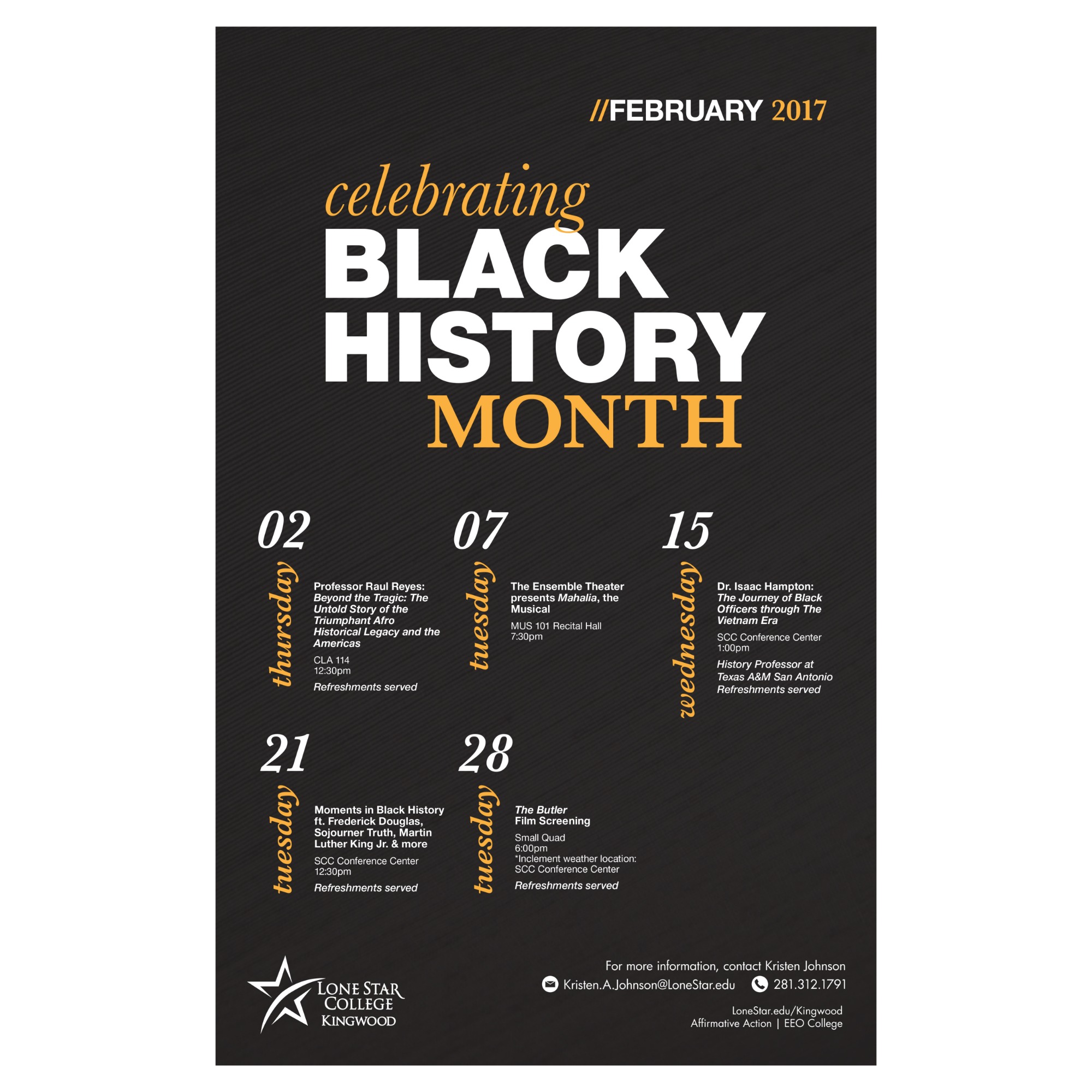 The official flier Black History Month upcoming Events for LSC-Kingwood starting Feb. 2 hosted by the Intercultural Center and Black History Month Committee.
Mahalia will be performed on LSC-Kingwood’s campus for one night only by The Ensemble Theatre of Houston, Texas. The admission is free and the performance is open to the public for viewing on February 7 at 7:30 p.m.
When asked what Black History month meant to her, Johnson stated that, “As the Director of Diversity and Equity, it is my job to make sure that everyone feels included, but it’s also my job to make sure we are educated…We can’t be culturally competent if we don’t know history. For me, I think it’s awesome being able to see students transform through this process or by attending these events and them saying, ‘Oh wow, I never knew that happened,’ or ‘You know, let me have a conversation with my peers, and maybe I can do something to change the world!’”
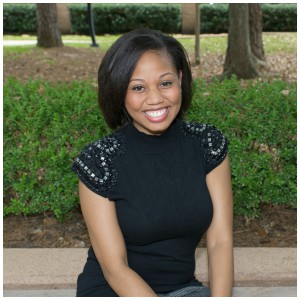
LSC-Kingwood Director of Diversity And Equity, Kristen Johnson serves as Black History Month Committee’s Co-Chair. She handles all of the logistics for the upcoming events in celebration of Black History Month.
By Cara Young, Columnist


When people think of the space race, the last thing on their minds would be African-American women working at NASA. On September 6, 2016, Margot Lee Shetterly reveals the hidden truth behind the space race in her book Hidden Figures. Just four months later, on January 6, 2017, the book was made into a major motion picture.The movie has been nominated for awards in the Oscars, Screen Actors Guild and the Golden Globes, including a nomination for Best Picture. Both the book and movie follow three African-American women; Katherine Johnson, Dorothy Vaughan and Mary Jackson through a behind the scenes story of the great space race. These three women were employed at NASA for a job that at the time was described as “human computers.” These women (among several others) solved complex mathematical equations by hand faster than the adding machines at that time. There doesn’t seem to be a number sequence they can’t handle. Even in 1960’s segregated Hampton, Virginia, these ladies make astronomical strides not only in racial equality but gender equality as well, all the while rising to the occasion of America’s greatest accomplishment.
Portraying our first prodigy, the character Katherine Johnson is portrayed by Empire actress Taraji P Henson who did a fantastic job shaving her normal level of self-confidence, attitude, and brilliant audacity to fit the mousey role presented in the film. Next, we have Octavia Spencer, a well-rounded actress taking on characters from serious to silly and sassing up every one of them, beautifully filling the heels of Dorothy Vaughan. Rounding out our leading ladies is the role of Mary Jackson played by singer/song writer, model, and actress Janelle Monae. Also, bringing a degree of star power to the supporting cast is Marvel’s Luke Cage, Mahershala Ali as Colonel Jim Johnson, Katherine’s love interest. Additionally, Big Bang Theory genius Jim Parsons as NASA genius. Paul Stafford and Draft Day actor Kevin Costner as Al Harrison took slots as some of NASA’s space program mathematical design leaders.
If that cast isn’t music to your ears, the actual soundtrack will be. Keeping true to the 60’s theme, the melody and lyrical appeal was defiantly identifiable with the time. Not a big surprise, however, when the dominating artist turned out to be Pharrell Williams bringing songs “I See Victory”, “Crave”, and “Able” into context seamlessly with the picture. Several other artists contributed to the film’s soundtrack, such as Ray Charles, Ruth Brown, Titus Turner, and Mary Jackson’s actress Janelle Monae, bringing their own brand of rhythm, funk and mad talent. Attributing the movie success to these factors with a slight bow to director Theodore Melfi, who you may not remember from films such as St. Vincent, Winding Roads, and The Story of Bob, because you probably didn’t know those were films in the first place. Regardless, this picture did its job. Hidden Figures was well-received, memorable, and a stunning step in American history that would have otherwise continued to be overlooked.
By Emily Slater, Copy Editor
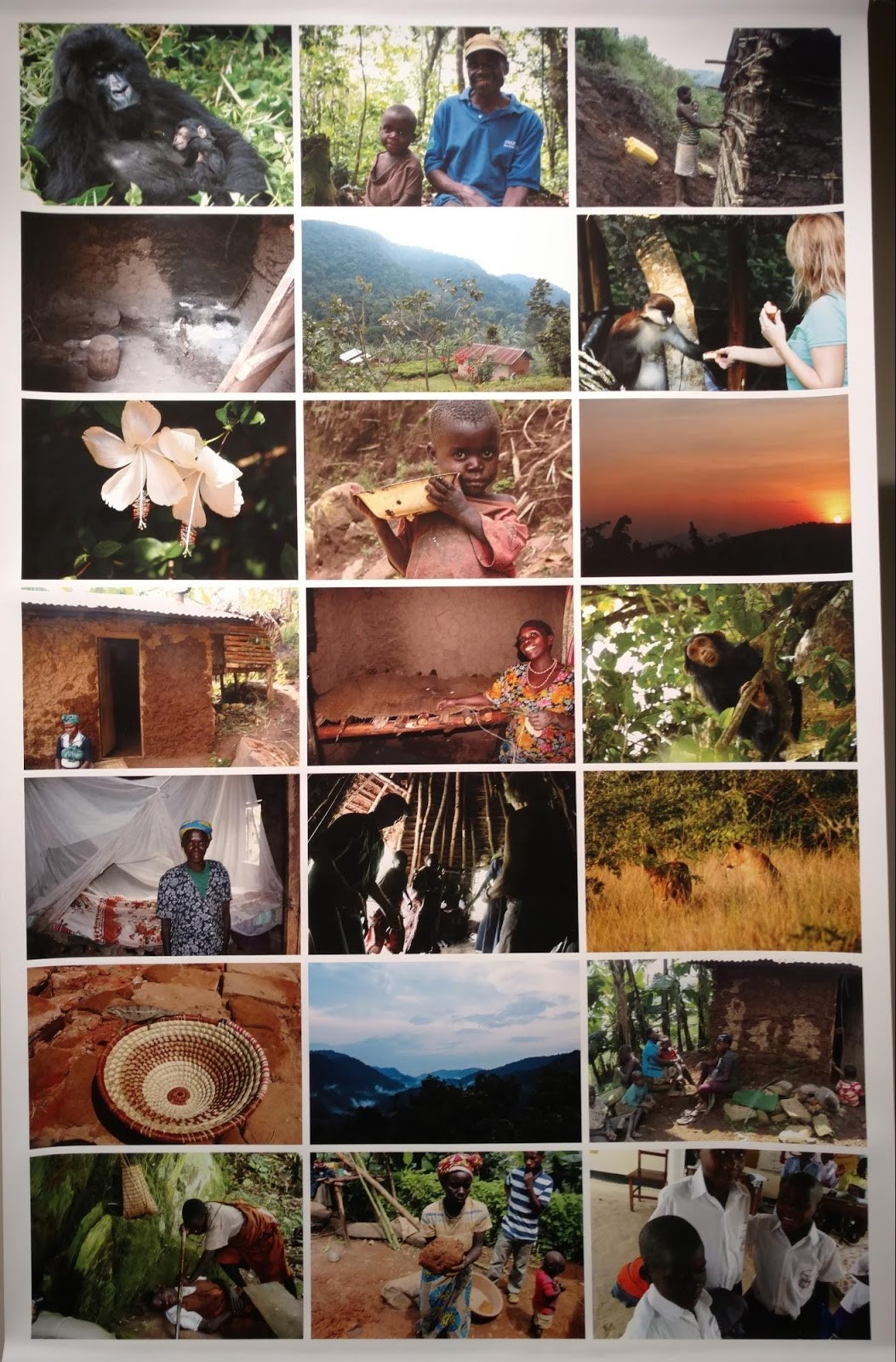 Batwa culture captured in poster collage on display in the LSC-Kingwood Fine Art Gallery. The images on this collage reflect the lives and living conditions of the Batwa. Jan. 25. Photo by Abigail Morar.
From her first encounter with the Batwa pygmies of Southwest Uganda in 2014, Wendee Nicole Holtcamp was prompted to uproot her life in Houston and move to Uganda to start Redemption Song Foundation. This foundation is a nonprofit dedicated to bettering the lives of the indigenous people evicted from Bwindi Impenetrable National Park through community development, education, and artisan co-ops, a program in which items made by the tribal peoples are bought and resold, with the income going back into the community development fund.
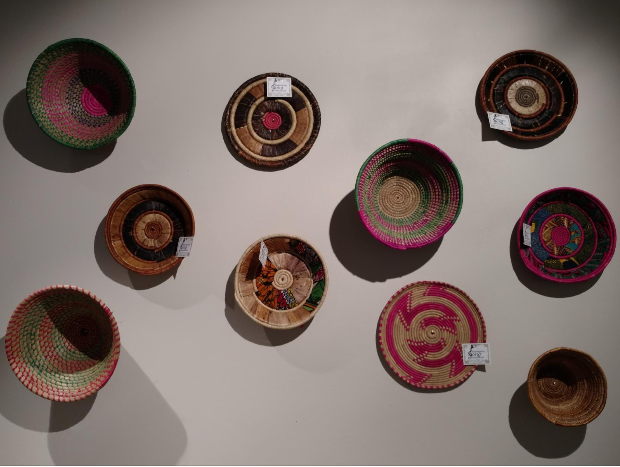 Straw baskets made by the Batwa women placed around the LSC-Kingwood Fine Art Gallery on Jan. 25. The woven baskets are selling at the Edge of Eden and proceeds go towards helping the Batwa pygmies. Photo of Abigail Morar.
According to Redemption Song Foundation, “people living near Bwindi Impenetrable Park suffer from some of the most abject poverty in all of Uganda.”
The Batwa are indigenous to what is now Uganda’s Bwindi Impenetrable National Park, created in 1991 in order to save the endangered mountain gorillas that used to dwell in the area. When the national park was established, the Batwa were forced from their home with no compensation, causing extreme poverty and a number of other societal issues within the Batwa community.
“The Edge of Eden” is Lone Star College–Kingwood’s first art show of the spring semester. The many photographs on display are just a few of the 5,000 photographs by Holtcamp which LSC-Kingwood students in Professor Brian Shmaefsky’s Environmental Science 1401 class sorted through for the exhibit. The exhibit also displays two models of Batwa dwellings, contrasting the Batwa’s living conditions before and after being evicted from their home in the amazon, and a short video about Redemption Song and the Batwa pygmies, all created by Shmaefsky’s Environmental Science 1401 classes.
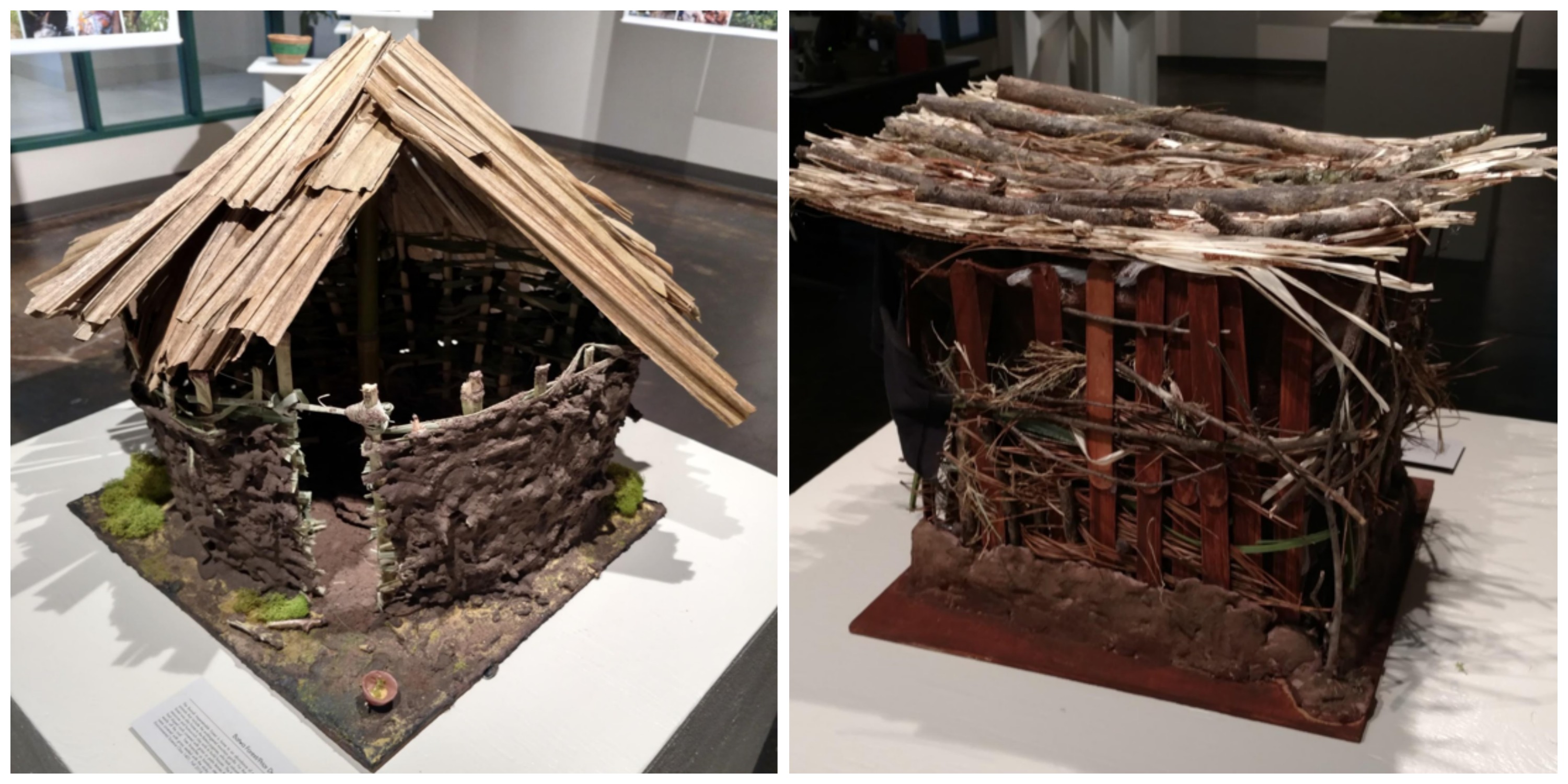 These 1/6th models of the Batwa Forest/Prior Dwelling were constructed by students of the Environmental Science 1401 class in the LSC-Kingwood Fine Art Gallery. The Batwa pygmies took advantage of the Bwindi Impenetrable Forest resources by using grass, palm leaves, bamboo stems, and humus-rich clay to build their houses. Jan. 25, Photos by Abigail Morar.
According to Shmaefsky, the message he hopes is portrayed by the exhibit is that “everything we do to protect the earth has consequences.”
The exhibit came together by accident after Shmaefsky and Fine Arts Gallery Director Kristine Larson ran into one another at a Redemption Song fundraiser. Shmaefsky saw the exhibit as the perfect opportunity to bring art into his science classes. The integration of art into STEM (science, technology, engineering, and mathematics) education is called STEAM (science, technology, engineering, art/design, and mathematics) education, of which Shmaefsky is an advocate.
The LSC-Kingwood Fine Art Gallery is open Monday throughThursday from 10 a.m. to 3 p.m. and is located in the Performing Arts Center. The last day to explore “The Edge of Eden” is February 7.
By Ashley Rico, Reporter
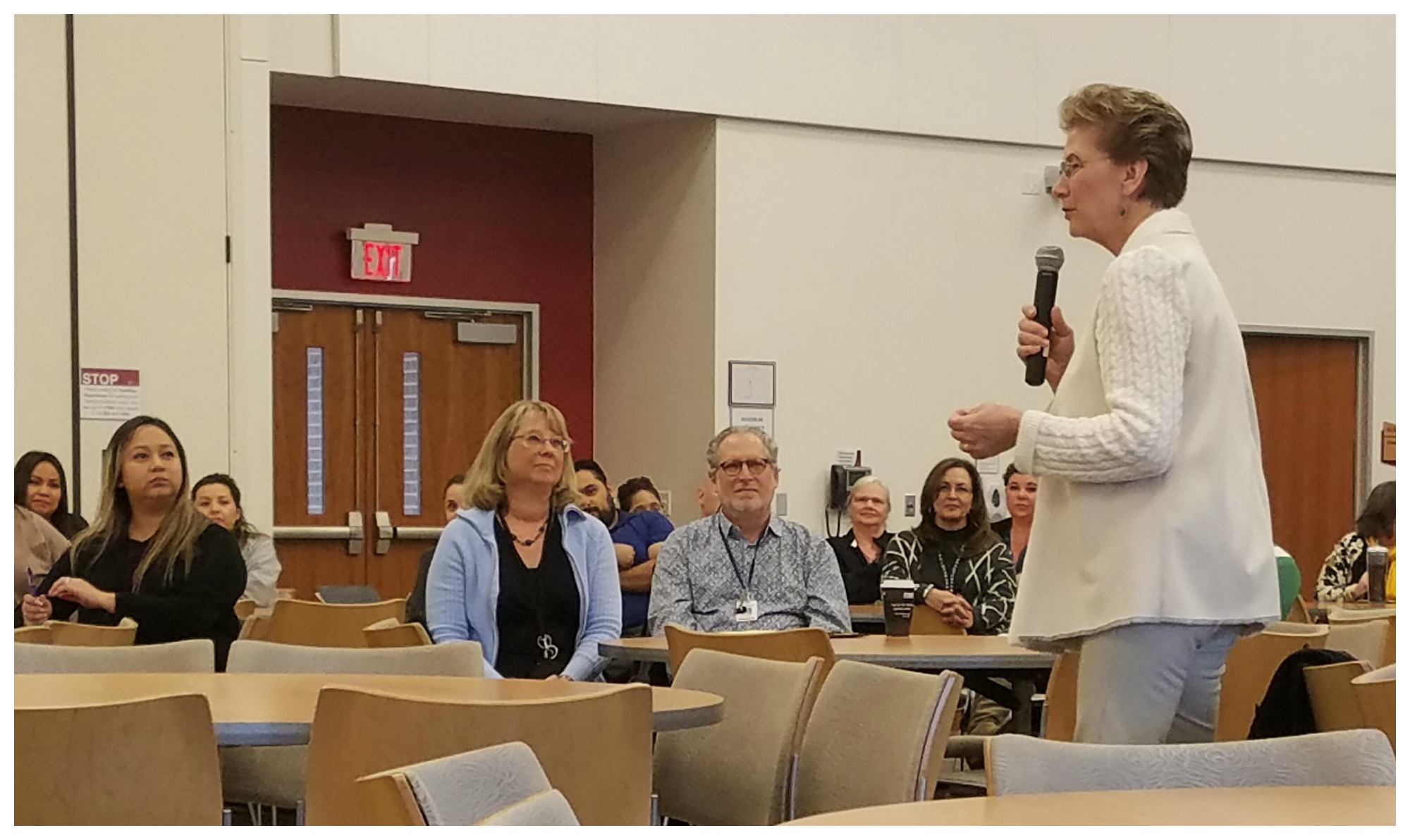 Lone Star College-Kingwood President Katherine Persson speaks to a crowd of faculty members in her informational meeting “What’s Up Doc?”, Thursday, Jan. 26, Student Conference Center auditorium. Persson closes the meeting with final thoughts on concerned issues of the campus. Photo by Ashley Rico.
President Katherine Persson recently addressed the concern of faculty members about parking permits and parking space.
In this past Thursday’s monthly informational meeting, “What’s Up Doc?,” some faculty members expressed their concern about students using faculty/staff parking permits and parking in faculty/staff parking spots.
Persson was unable to provide a concrete reason as to how and why some students might have acquired faculty/staff parking permits. In response to the campus’s current issue with parking space, she said, “I, myself, do not have a designated parking spot.”
One particular factor of the parking space issue could be the increase of enrollment each year at LSC-Kingwood. Persson announced in this informational meeting that since last spring semester, enrollment has gone up by three percent.
There were several other concerns and announcements presented in the meeting. A faculty member suggested that a stoplight be placed at the four-way intersection of Kingwood Place Drive and Kingwood Drive to help better control the traffic.
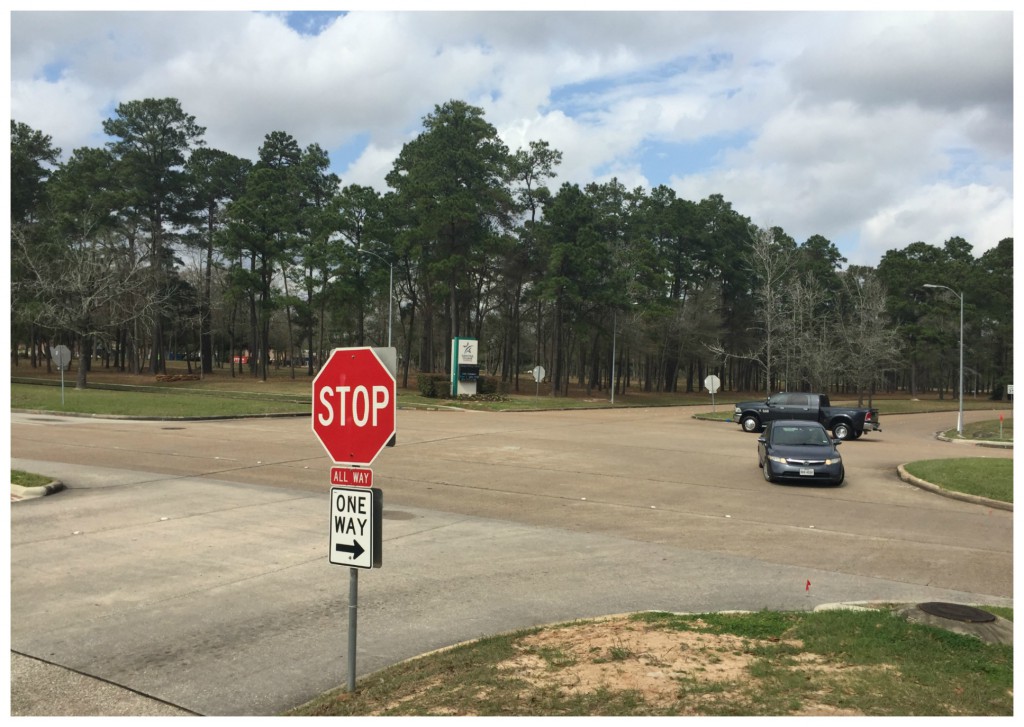 Intersection of Kingwood Place Drive and Kingwood Drive. During the What’s Up Doc? Informational meeting on Feb. 2, a faculty member gave President Katherine Persson the suggestion to put a stoplight in this intersection. Photo by Michelle Lecumberry.
Persson noted the next phase for LSC-Kingwood of the 2014 Bond Referendum, a Lone Star College system-wide improvement plan. Phase two of this major project (which spans from July 2016 and June 2018) includes the construction of a new Healthcare Instructional Building that is to be 60,000 square feet (along with the expansion of healthcare programs) and the increase in parking space by 550 spaces. To learn more about the 2014 Bond Referendum and of the projects and progress specific to LSC-Kingwood, please visit this website, http://www.lonestar.edu/2014-bond-referendum.htm.
Persson also announced that LSC-Kingwood has recently hired a new Veterans Advisor, Rogelio Espinoza, who is an Army veteran himself.
Espinoza has helped develop a new Veterans Club and also wants to host a panel of speakers, projected to be in March, on how to help veterans cope with post-traumatic stress disorder and suicidal thoughts.
Administration has also hired new Police Captain Edwin Gomez, who also serves as the LSC System trainer for handling active shooters.
By Ashley Rico, Reporter
 History Professor Raul Reyes gives lecture for the opening of the Black History Month celebration at Lone Star College-Kingwood, Feb. 2, Classroom Building A building. Photo by Ashley Rico.
Did you know there’s a high possibility that Africans were the first to discover the Americas in as early as 500 B.C., even before the well-renowned 1492 voyage of Christopher Columbus?
As a way to kick off Black History Month at Lone Star College-Kingwood, history Professor Raul Reyes presented his research on African and Afro-Latino origins of the Americas, titled “The Untold Story of the Triumphant Afro Historical Legacy and the Americas,” on February 2.
According to Daryl M. Scott, a professor at Harvard University, Black History Month originated in 1926 from a one-week celebration of the black community’s progress in the second week of February coined the “Negro History Week.” The celebration was created by historian Carter G. Woodson with the help of his colleagues. The reason why Woodson placed the celebration in February is because of the black community’s long tradition, at the time, of celebrating the February birthdays of Frederick Douglass (since 1890s) and Abraham Lincoln (since his assassination in 1865). It wasn’t until 1976 when President Gerald R. Ford officially recognized February as “Black History Month.”
Though, while some people often think of Frederick Douglass in the name of Black History Month, Reyes decided to present information of black history that goes beyond reverting back to just the Civil Rights era and the emancipation of slaves in the United States.
Reyes presented the Olmecs, a well-known civilization of people who are commonly characterized with Mesoamerican origins by many scholars. However, Reyes introduced non-mainstream research that claims the Olmecs are of African origins, saying that they were the first to contribute in the development and introduction of calendars and mathematics in Africa and the Americas.
 An Olmec colossal stone head, Creative Commons, Photo by Jesús Gorriti. License: https://creativecommons.org/licenses/by-sa/2.0/. No changes were made.
Once Reyes arrived at, in his research, the origins of black enslavement in North America, he points to Esteban, the first African slave of North America and the first few non-natives to explore North America in the 1500s.
Esteban was sold into slavery to a man named Andres Dorantes de Carranza, who then took him on an expedition to North America. Before they landed, they got attacked by Native Americans from the Gulf of Mexico in what is modern-day Galveston. After being enslaved for years by Native Americans, where he learned and studied their culture and language, Esteban traveled 15,000 miles across North America. Eventually, Esteban was killed by Native Americans who saw him as a threat. He was one of the few non-natives who had seen much of North America.
Reyes said that the reason he chose to talk about Esteban is because he wanted people to recognize those we don’t talk about.
This is Reyes’ second time providing a black history presentation to commemorate Black History Month on campus, in which, he expressed, he eagerly volunteered to do.
“The primary reason that I did it was [because]…I [wanted] to make sure no one pigeonholes me–that they see me and the presumptions are made that my knowledge about history is limited strictly to the Latino experience, Mexican experience,” Reyes said. “I don’t appreciate that, I consider myself an ethnic studies student–that I do my research; I do it with the intent…of telling the untold story.”
LSC-Kingwood student Greg Kisschke attended the discussion with his wife in part “to fulfill class campus activity” for his U.S. History class, as well as to gain new historical knowledge; what Reyes’ presented they considered unconventional and not often explored or even mentioned in some history classes.
“We have an interest in non-typical history,” Kisschke said. “This was a very interesting, unique [piece of] information, though not surprising. [It is] good to hear facts,” Kisschke said.